
Few things worry parents more than a child who isn't talking as much as other children their age. Children develop at different speeds, and many late talkers catch up. But some need extra support, and finding out early gives them the best start. This guide covers typical milestones, the signs worth getting checked and what happens at a speech therapy assessment.
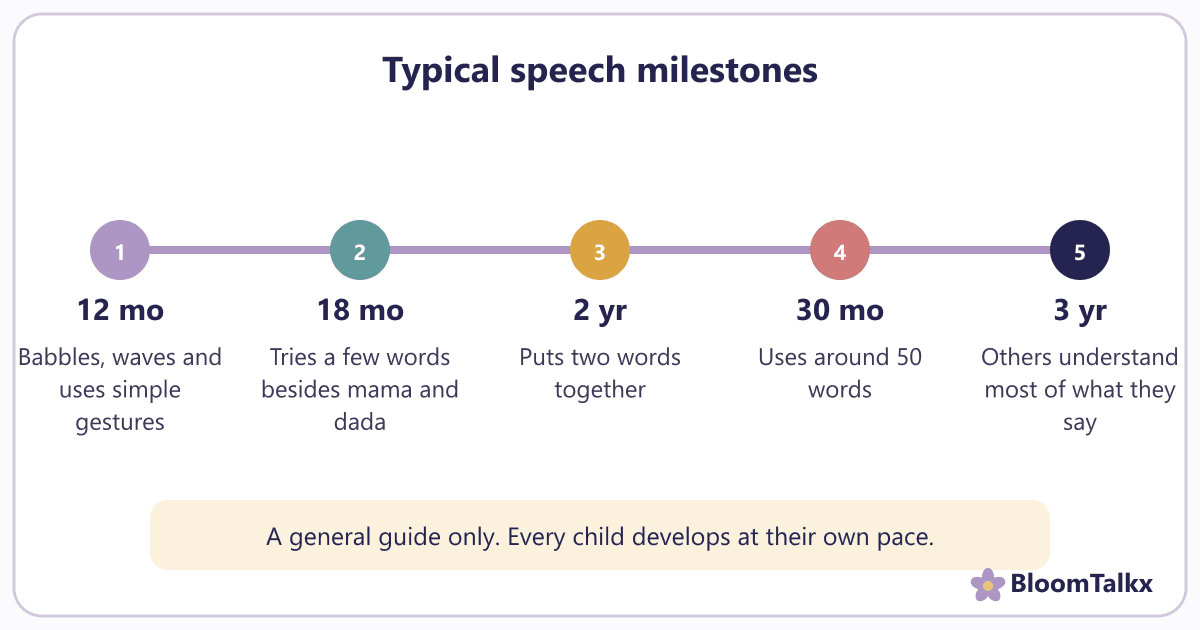
Late talker, or something more?
A late talker is a toddler who understands what is said to them, plays and interacts well, but has fewer words than expected. Some catch up on their own. Others have a language delay, a hearing problem or a developmental difference that needs support. You can't tell which from the outside, which is why an assessment is more useful than waiting and worrying.
Signs worth a professional look
- No babbling, pointing or waving by about 12 months.
- Very few or no words by around 18 months to 2 years.
- Not putting two words together by about 2 to 2½ years.
- Doesn't respond when called, or you worry about their hearing.
- Limited eye contact, or little interest in sharing attention, play or pointing things out.
- Speech that is very hard for family to understand by 3 years.
- Any loss of words or skills they previously had. Don't wait; see a paediatrician promptly.
Check hearing first
Hearing problems, including those caused by repeated ear infections or fluid in the ear, are a common and treatable reason for delayed speech. A hearing test is often the first step before or alongside a speech assessment.
What a speech therapy assessment involves
- A conversation about your child's birth, health, development and home languages.
- Observation of how your child plays, communicates and understands instructions.
- Structured activities to check understanding, speech sounds and expression.
- A plan with goals, how often to attend and what to practise at home.
Growing up with more than one language
Hearing Urdu, Punjabi, Pashto, Sindhi and English at home does not cause speech delay. Mixing languages in a sentence is normal for bilingual children. A good assessment looks at all your child's languages together, not just one.
What you can do at home
- Talk through daily routines such as bath time, meals and getting dressed. Name what you see and do.
- Read picture books together, pointing at and naming the pictures.
- Offer simple choices, such as 'milk or juice?', and pause to give your child time to answer.
- Repeat what your child says and add a word. If they say 'ball', you say 'big ball'.
- Reduce passive screen time and swap it for talking, singing and play.